

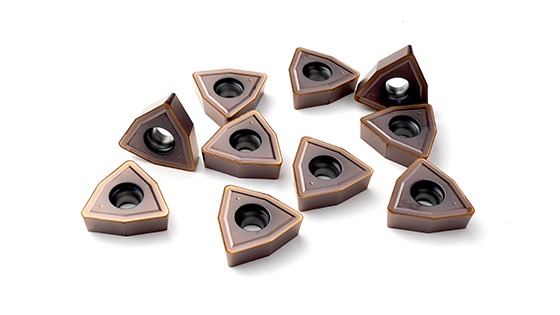
Solid cemented carbide cutting tools have revolutionized the machining industry with their exceptional performance and reliability. These tools are crafted entirely from cemented carbide, a composite material renowned for its remarkable hardness, wear – resistance, and high – temperature stability. Unlike insert – based tools where only the cutting tip is made of carbide, solid cemented carbide cutting tools offer a seamless and robust structure, enabling them to tackle a wide range of demanding machining tasks with precision and efficiency.The primary components of cemented carbide used in these tools are tungsten carbide (WC) particles as the hard phase, bonded together by a metallic binder, usually cobalt (Co). This composition endows the tools with extraordinary hardness, often reaching 89 – 94 HRA on the Rockwell hardness scale. Such hardness allows solid cemented carbide cutting tools to maintain sharp cutting edges even when machining tough materials like hardened steels, cast irons, and superalloys, which would quickly dull conventional cutting tools. Additionally, the high – temperature stability of cemented carbide is a significant advantage. These tools can withstand the intense heat generated during high – speed machining without losing their structural integrity or performance, making them ideal for applications where rapid material removal is required.One of the key features of solid cemented carbide cutting tools is their ability to achieve high precision. Their fine – grained structure and consistent material properties enable the creation of complex geometries with tight tolerances. For instance, in the production of precision components for the aerospace and automotive industries, where dimensional accuracy is critical, solid cemented carbide end mills and drills can machine parts with exceptional precision, ensuring a perfect fit and optimal functionality. The seamless construction of these tools also contributes to reduced vibration during machining, further enhancing the accuracy of the finished product.Solid cemented carbide cutting tools come in various forms to suit different machining operations. End mills are among the most commonly used types. They can be designed with different numbers of flutes, helix angles, and cutting edge geometries to perform tasks such as slotting, contouring, and face milling. Their sharp and durable cutting edges allow for smooth chip formation and efficient material removal, resulting in excellent surface finishes. Drills made from solid cemented carbide are highly effective for drilling holes in hard materials. Their high hardness and wear resistance ensure that the drill bit maintains its diameter and cutting performance over a large number of holes, reducing the need for frequent tool changes and improving productivity.

In the manufacturing of micro – components, such as those used in the electronics and medical device industries, solid cemented carbide cutting tools shine due to their ability to machine small and intricate features. The fine – grain carbide material can be ground to extremely sharp edges, enabling the creation of tiny holes, slots, and profiles with high precision. Moreover, the tool’s rigidity and stability allow for reliable machining of these delicate parts without causing deformation or damage.Another advantage of solid cemented carbide cutting tools is their long tool life. Thanks to their superior wear – resistance, they can withstand the abrasive forces generated during machining for extended periods. This not only reduces the frequency of tool replacements but also minimizes the associated costs, including both the cost of the tools themselves and the downtime required for tool changes. In high – volume production environments, the extended tool life of solid cemented carbide cutting tools can significantly improve overall production efficiency and reduce the cost per part.However, it’s important to note that solid cemented carbide cutting tools do have some limitations. They are relatively brittle compared to some other tool materials, which means they require careful handling and proper machining conditions to prevent breakage. Additionally, they can be more expensive than tools made from other materials, but the enhanced performance and longer tool life often justify the higher initial investment.In conclusion, solid cemented carbide cutting tools are indispensable assets in modern machining. Their unique combination of high hardness, precision, versatility, and long tool life makes them essential for a wide range of applications across various industries. As manufacturing demands continue to evolve, these tools will likely remain at the forefront of innovation, enabling the production of high – quality components with ever – increasing precision and efficiency.
Contact us:[email protected]