

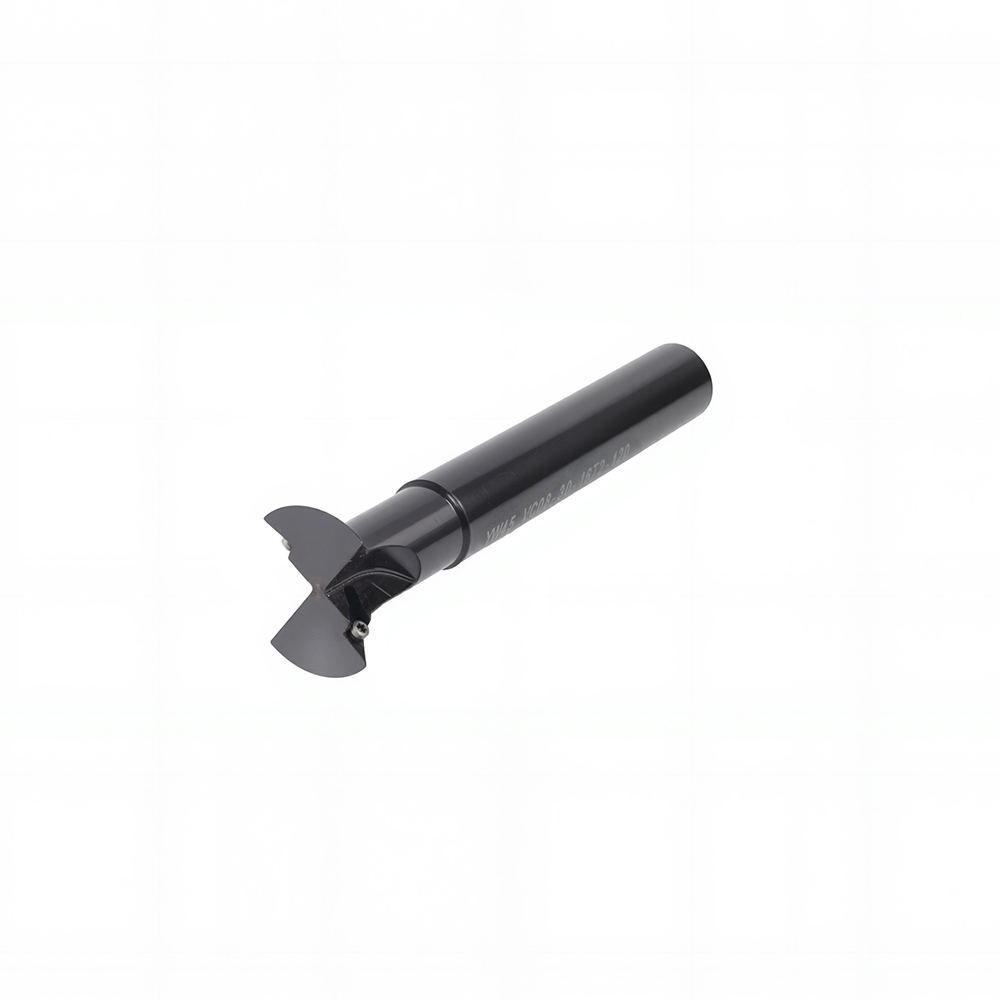
Dovetail cutters (also called dovetail end mills) are essential for machining undercuts, angled grooves, and precision mold cavities. One key factor in their performance is the cutter’s included angle—commonly 45°, 60°, or 55°. But how does this angle impact machining? Let’s break down the differences.
1. 45° Dovetail Cutters – For Fine Detailing
Best for: Delicate work in softer materials (aluminum, plastics).
Advantage: The shallow angle allows tighter access to intricate features.
Trade-off: Less rigidity than steeper angles; not ideal for heavy cuts.

2. 60° Dovetail Cutters – The Balanced Choice
Best for: General-purpose machining (steel, cast iron).
Advantage: Combines good strength and accessibility.
Why common?: Matches standard dovetail slides in machine tools.

3. 55° Dovetail Cutters – The Versatile Performer
Best for: Semi-finishing operations in medium-hard materials (alloy steels, bronze).
Advantage: Offers an optimal balance between strength and accessibility.
Limitation: Slightly less rigid than 60° cutters for heavy roughing.

Angle vs. Tool Life & Surface Finish
Steeper angles: distribute cutting forces better, extending tool life.
Shallower angles :produce finer finishes but wear faster.
Matching the Angle to Your Application
Check mating parts: Use the same angle as existing dovetails (e.g., 60° for machine tool slides).
Consider access: Narrow spaces may require 45° cutters.
Prioritize strength: For deep cuts, choose 60° or 90°.
Pro Tip: Non-Standard Angles
Some industries use specialized angles (e.g., 30° for optical mounts). Always verify requirements before selecting a cutter.
Conclusion
The dovetail angle directly impacts rigidity, precision, and suitability for specific materials. While 60° is the most versatile, understanding these differences helps optimize your machining process.
Have you encountered challenges with dovetail angles? Contact us:[email protected]