

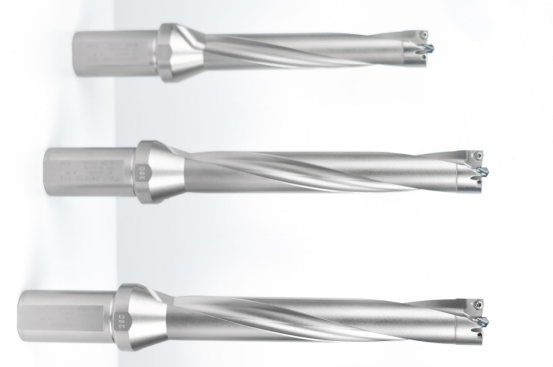
The U-Drill (commonly referred to as an indexable drill or insert drill) represents a significant leap forward in drilling technology, offering manufacturers unparalleled efficiency when creating large-diameter holes with exceptional precision and remarkable speed. Unlike traditional twist drills that require complete replacement when worn, these innovative tools utilize replaceable carbide inserts, dramatically reducing long-term tooling costs while boosting productivity through faster machining times and simplified maintenance.

By combining advanced insert geometries with optimized coolant delivery systems, U-Drills achieve superior chip evacuation and extended tool life, even when machining challenging materials like stainless steel, cast iron, and high-temperature alloys. Their unique design allows for both roughing and finishing operations in a single pass, minimizing machine downtime while maintaining tight tolerances – a game-changing advantage for high-volume production environments where consistency and cost control are paramount.
Types of U-Drills
1. Standard U-Drill (Single-Insert Type)
Features a single cutting insert at the tip.
Suitable for general-purpose drilling in steel, cast iron, and non-ferrous metals.
Provides good chip evacuation due to its open design.
2. Twin-Insert U-Drill (Double-Insert Type)
Uses two inserts (one at the center and one at the periphery).
Offers better balance and higher feed rates than single-insert drills.
Ideal for larger diameters (typically above 20mm).
3. Coolant-Thru U-Drill
Designed with internal coolant channels for high-pressure coolant supply.
Improves chip evacuation and extends tool life in deep-hole drilling.
Commonly used in stainless steel, titanium, and other tough materials.
4. Modular U-Drill (Interchangeable Head System)
Allows quick replacement of drill heads without changing the entire tool.
Reduces downtime and increases flexibility in machining operations.
Cost-effective for multi-diameter hole drilling.
5. High-Penetration U-Drill (Optimized for Hard Materials)
Features reinforced inserts and specialized geometries for drilling hardened steels (HRC 45+).
Often used in aerospace and mold-making industries.
Key Characteristics of U-Drills
1. High Efficiency
Faster drilling speeds compared to conventional twist drills.
Reduces cycle time in mass production.
2. Cost-Effective
Replaceable inserts lower tool costs (no need to replace the entire drill).
Multiple edges per insert maximize tool life.
3. Excellent Chip Evacuation
Open flute design prevents chip clogging.
Coolant-thru variants further enhance chip removal.
4. High Precision & Stability
Provides better hole straightness and surface finish.
Reduced vibration due to rigid tool construction.
5. Versatility
Can drill through various materials, including steel, cast iron, aluminum, and composites.
Some models allow for boring and chamfering operations.

Conclusion
U-Drills offer significant advantages over traditional drills, including higher productivity, cost savings, and better performance in demanding applications. Choosing the right type depends on material, hole size, and machining conditions. By understanding their features, manufacturers can optimize drilling operations for efficiency and precision.
Wencerl U-Drill: Revolutionizing large-hole drilling with indexable carbide inserts for unmatched precision, speed, and cost efficiency in modern machining.
Have you used U-Drills in your projects? Contact us:[email protected]