

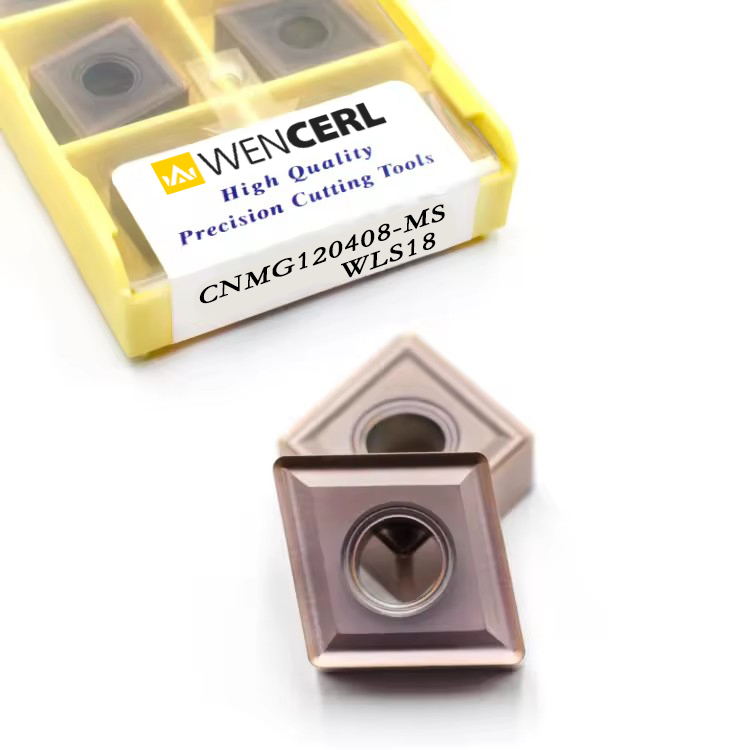
When it comes to the selection of machining inserts, several critical factors demand careful consideration to ensure optimal machining performance, efficiency, and cost – effectiveness.Insert MaterialThe material of the machining insert is of utmost importance. Carbide inserts are widely popular due to their excellent balance of hardness, toughness, and wear resistance. They can handle a broad range of materials and cutting conditions, making them suitable for both roughing and finishing operations. Ceramic inserts, on the other hand, offer superior hardness and can operate at much higher speeds, making them ideal for machining hard materials such as hardened steels and nickel – based alloys. Cermet inserts combine the properties of ceramics and metals, providing good wear resistance and edge strength, often used in semi – finishing operations. Additionally, cubic boron nitride (CBN) inserts are extremely hard and are specifically designed for machining very hard materials, while polycrystalline diamond (PCD) inserts are perfect for non – ferrous materials and abrasive composites. Matching the insert material to the workpiece material is crucial for efficient cutting and extended tool life.Geometry and Edge PreparationThe geometry of the machining insert significantly impacts the cutting process. Different geometries are designed for specific machining tasks. For instance, inserts with a positive rake angle reduce cutting forces and are suitable for materials that are prone to work – hardening, while negative rake angle inserts offer stronger cutting edges and are better for machining tough materials. The edge radius also plays a role; a sharp edge is ideal for achieving a fine surface finish but may be more prone to chipping, whereas a honed or rounded edge provides increased edge strength at the expense of a slightly coarser finish. Moreover, the number of cutting edges on the insert affects both the cost – per – edge and the machining efficiency. Inserts with more cutting edges can be rotated or indexed multiple times, reducing the overall cost, but might require more precise machining setups.

CoatingCoatings on machining inserts can greatly enhance their performance. TiN (Titanium Nitride) coatings are common and provide good wear resistance and a low coefficient of friction, reducing the tendency for built – up edge formation. TiAlN (Titanium Aluminum Nitride) coatings offer higher hardness and better thermal stability, allowing for higher cutting speeds, especially when machining heat – resistant alloys. DLC (Diamond – Like Carbon) coatings are excellent for reducing friction and are often used when machining sticky or abrasive materials. The choice of coating depends on the workpiece material, cutting conditions, and the desired tool life and surface finish. A well – chosen coating can not only extend the life of the insert but also improve the quality of the machined surface.Machining ConditionsThe specific machining conditions, including cutting speed, feed rate, and depth of cut, also influence insert selection. High – speed machining requires inserts with good thermal stability and wear resistance to withstand the increased heat generated. When machining at low speeds, inserts with better toughness may be more appropriate to prevent edge chipping. The feed rate affects the chip load on the insert, and a higher feed rate might necessitate inserts with stronger cutting edges. Similarly, the depth of cut determines the amount of material removed in each pass, and deeper cuts require inserts that can handle higher cutting forces. Understanding and matching the insert to the expected machining conditions is essential for achieving efficient and reliable machining operations.

Machine Tool CompatibilityThe compatibility of the machining insert with the machine tool is often overlooked but is a vital consideration. The insert’s size, shape, and mounting style must be compatible with the tool holder and the machine’s spindle. Some machine tools have specific requirements regarding the balance and rigidity of the cutting tools, and inserts that do not meet these requirements can cause vibrations during machining, leading to poor surface finish and reduced tool life. Additionally, the coolant delivery system of the machine tool may need to be considered. Inserts with internal coolant holes can enhance chip evacuation and cooling, but they require a machine tool with a corresponding coolant delivery mechanism.In conclusion, choosing the right machining insert involves a comprehensive evaluation of the insert material, geometry, coating, machining conditions, and machine tool compatibility. By carefully considering these factors, machinists can make informed decisions that lead to improved machining performance, extended tool life, and reduced production costs, ultimately ensuring the success of their machining projects.
Contact us:[email protected]