

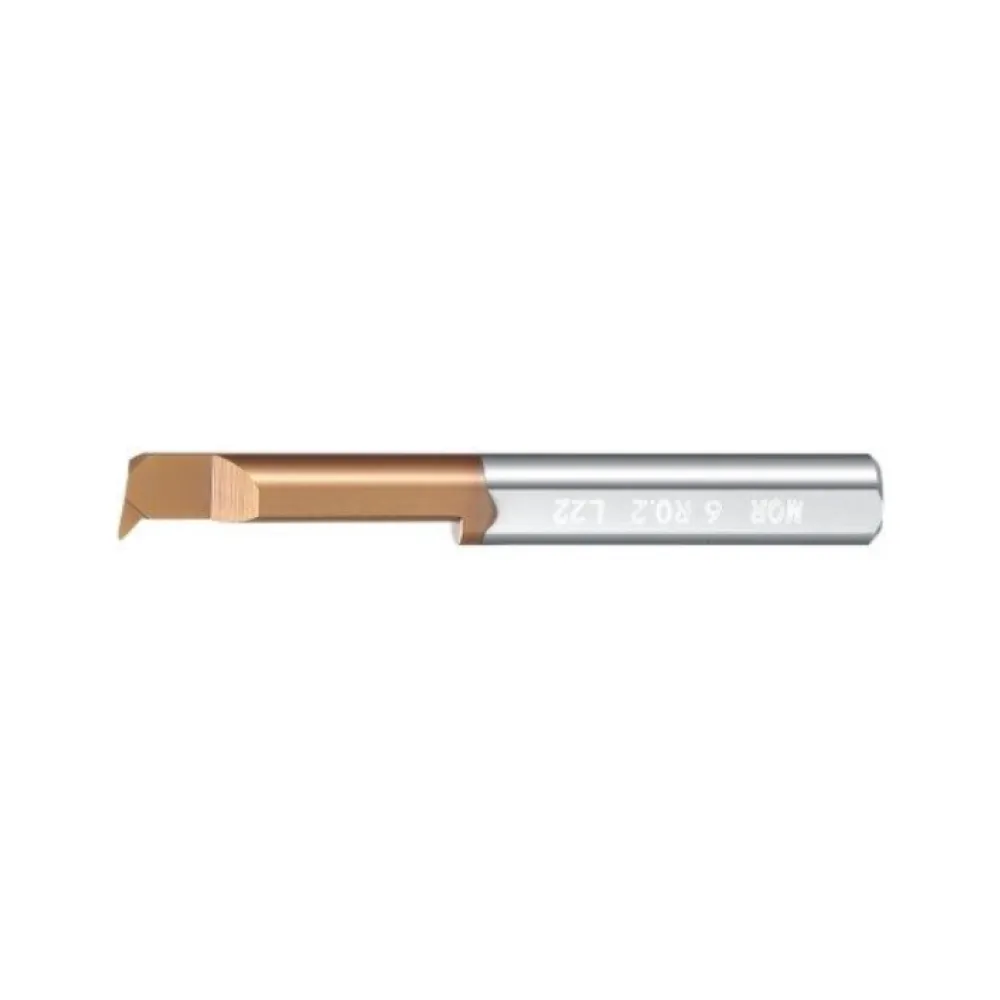
Optimized Tool Geometry Configuration
Precision-engineered cutting edges with 0.03mm honing and 15° positive rake angles reduce cutting forces by 30%. Material-specific geometries include 0.15mm edge prep + 25° helix for steel, 45° helix + mirror-polished rake face for aluminum, and 18° helix + 0.1mm reinforced edge for stainless steel. Advanced variable-helix designs (30-45° progressive) effectively suppress vibration, demonstrating 40% higher metal removal rates in Φ3-8mm boring applications.
Intelligent Cutting Parameter Optimization
Dynamic parameter models based on material databases recommend Vc=80-120m/min for 42CrMo (upper range for finish boring) with adaptive feed rates from 0.08-0.15mm/rev. The patented “stepped parameter method” combines rough boring at fn=0.2mm/r with finish passes at fn=0.05mm/r to achieve Ra0.4. High-frequency spindles (20,000rpm) with 0.02mm micro-vibration cutting overcome conventional speed limitations for small diameters.
Advanced Cooling and Lubrication Systems
High-pressure internal coolant (7MPa) with biodegradable oil (5μm mist particles) targets the cutting zone directly. Cryogenic cooling (-20℃) extends tool life 3X in titanium alloys. For deep-hole boring (L/D>8), vortex-generating coolant nozzles create swirling flow patterns that reduce cutting temperatures by 150℃. State-of-the-art phase-change cooling technology achieves 5X better heat absorption through instantaneous vaporization at the tool-chip interface.

Dynamic Stability Enhancement
Micro-accelerometers monitor vibration spectra in real-time, with active dampers suppressing chatter within 0.1 seconds. Asymmetric flute spacing (3 unequal edges) breaks harmonic resonance, permitting 8xD overhang. Carbon fiber composite tool bodies provide 60% better vibration damping than steel while retaining 85% rigidity. Digital twin-based pre-tuning simulates and optimizes process stability before physical cutting.
Smart Wear Management
Machine vision systems monitor flank wear with 0.005mm resolution. Adaptive wear-compensation models automatically adjust offset (+0.03mm) and speed (+5%) when VB reaches 0.1mm. Multilayer gradient coatings (TiAlN/AlCrO/SiN) promote uniform wear distribution, while self-lubricating coatings release WS2 nanoparticles at high temperatures, reducing friction coefficient to 0.15.
Process Chain Integration
Optimal roughing allowances of 0.3mm (diameter) balance efficiency and precision. Helical interpolation boring improves productivity by 50% versus linear boring. Combined drill-bore tools complete hole-making operations in single setups, reducing tool change time by 80%. Synchronized back-chamfering with turning centers eliminates secondary operations.
Digital Twin Applications
Complete tool lifecycle modeling predicts optimal change intervals with 95% accuracy. Cutting force simulations optimize toolpaths virtually, minimizing trial cuts. AR interfaces overlay ideal parameters in real-time, reducing operator training time by 70%. Cloud-based collaborative systems automatically retrieve optimal strategies for similar components.
Industry tests confirm these integrated techniques triple productivity in Φ3mm carbide boring while maintaining IT6 tolerances consistently. Emerging AI autonomous optimization systems and nanocrystalline carbide substrates promise to further突破 the physical limits of small-diameter boring efficiency. The future lies in self-optimizing boring systems that automatically adapt to varying conditions while maintaining peak performance throughout the tool’s service life. Proper implementation of these strategies transforms small-hole boring from a bottleneck into a high-efficiency process.
Contact us:[email protected]