

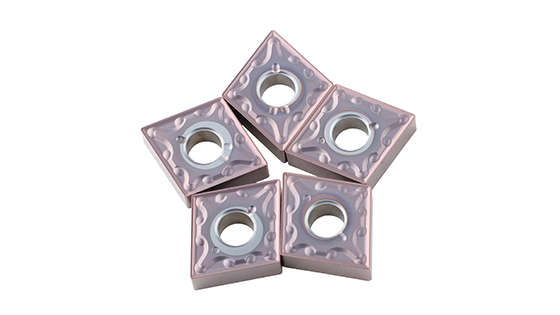
In the realm of machining and manufacturing, cermet and cemented carbide are two widely – used materials, each with its unique characteristics. Understanding their differences is essential for making informed decisions about tool selection and application in various industrial processes.CompositionCermet, short for ceramic – metal, is a composite material that combines the properties of ceramics and metals. It mainly consists of metallic compounds such as titanium carbide (TiC), titanium nitride (TiN), or titanium carbonitride (TiCN) as the hard phase, bonded together with a metallic binder, usually nickel (Ni) or molybdenum (Mo). This combination gives cermet a balance of high hardness from the ceramic phase and good toughness from the metallic binder. Cemented carbide, on the other hand, typically features tungsten carbide (WC) particles as the hard phase, which are bonded with cobalt (Co) as the binder. In some cases, other carbides like titanium carbide or tantalum carbide may be added to enhance specific properties. The high proportion of tungsten carbide in cemented carbide contributes to its extreme hardness and wear resistance.Mechanical PropertiesCermet offers a good combination of hardness and toughness. Its hardness is generally lower than that of cemented carbide but still sufficient for many machining applications, often ranging from 85 – 93 HRA. Cermet has better resistance to adhesive wear and can maintain a sharp cutting edge for a relatively long time, which makes it suitable for semi – finishing and finishing operations. It also has lower friction coefficients, reducing the tendency for built – up edge formation when machining certain materials. Cemented carbide, however, is renowned for its superior hardness, typically reaching 89 – 94 HRA. It can withstand higher cutting forces and temperatures, making it ideal for roughing operations and machining hard materials such as hardened steels, cast irons, and superalloys. While cemented carbide is extremely hard, it is more brittle compared to cermet, and care must be taken to avoid excessive impact or vibration during machining to prevent tool breakage.

Cutting PerformanceDuring machining, cermet tools perform well in applications where a good surface finish and relatively low cutting forces are required. They are particularly effective when machining ferrous materials like steel, especially in high – speed cutting scenarios. Cermet’s ability to resist built – up edge and its lower friction properties result in reduced heat generation at the cutting edge, allowing for smoother cutting and improved surface quality. Cemented carbide tools, with their high hardness and wear resistance, can handle heavy – duty cutting tasks. They can cut through tough materials at high speeds and depths of cut, removing large amounts of material quickly. However, due to their brittleness, cemented carbide tools may require more precise machining conditions and proper coolant application to maintain optimal performance and prevent premature wear or breakage.Application FieldsCermet is commonly used in semi – finishing and finishing operations of steel components, such as in the automotive industry for machining engine parts, transmission components, and shafts. It is also suitable for high – speed turning and milling of stainless steels. In the electronics industry, cermet tools can be used for machining precision components due to their ability to achieve fine surface finishes. Cemented carbide, on the other hand, has a broader application range in heavy – duty machining. It is widely used in the mining industry for cutting tools in excavators and drills, in the aerospace industry for machining high – strength alloys in aircraft components, and in the general metalworking industry for roughing and shaping operations of various metals and alloys.CostIn terms of cost, cermet is usually more expensive than cemented carbide. The manufacturing process of cermet involves more complex techniques to achieve the desired combination of ceramic and metallic phases. Additionally, the raw materials used in cermet production, especially the titanium – based compounds, can be costlier. Cemented carbide, with its more established manufacturing process and relatively abundant raw materials (tungsten carbide and cobalt), is generally more cost – effective, making it a popular choice for a wide range of applications where high – performance cutting tools are needed at a reasonable price.In conclusion, cermet and cemented carbide have distinct differences in composition, mechanical properties, cutting performance, application fields, and cost. By understanding these differences, manufacturers and machinists can select the most appropriate material for their specific machining needs, optimizing production efficiency, reducing costs, and achieving high – quality machining results.
Contact us:[email protected]