

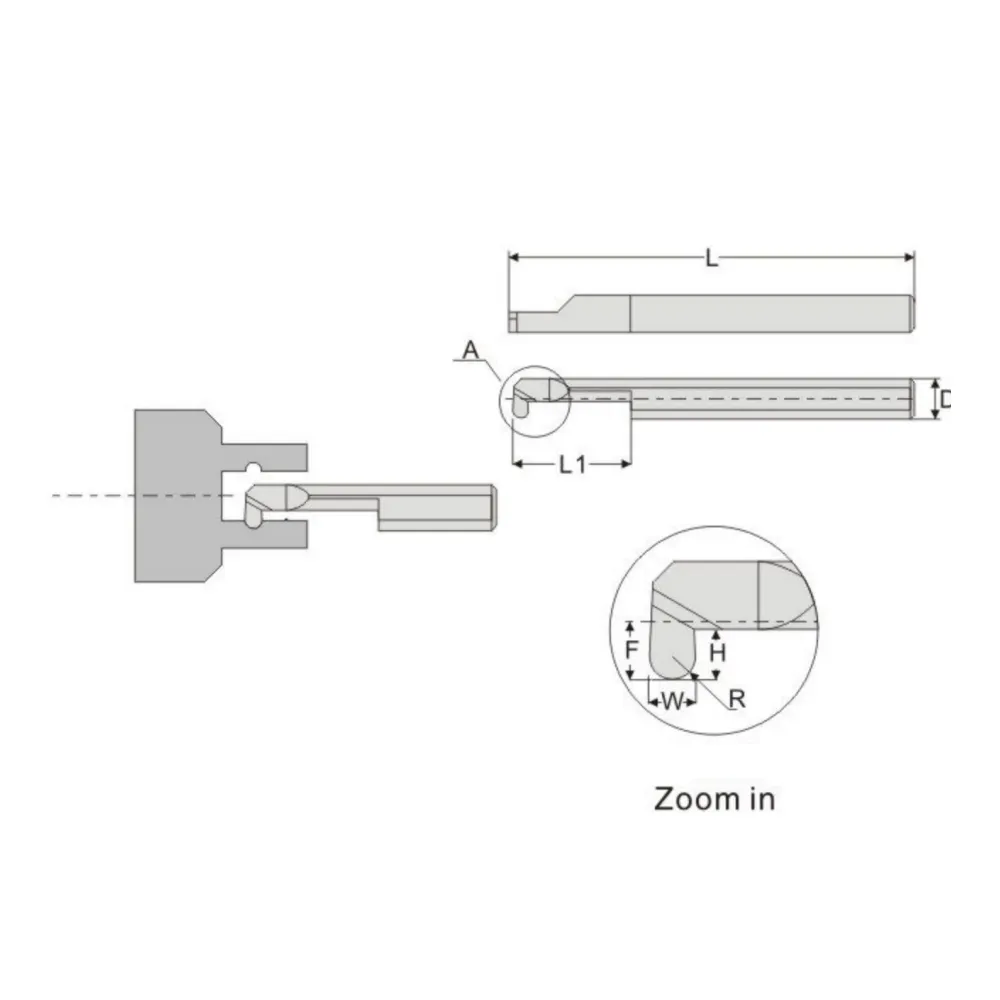
Precision Engineering Design Principles
MKR-type boring tools represent a paradigm shift in internal machining technology, featuring a unique modular quick-change system that achieves ±0.005mm repeatability without requiring recalibration. Their patented anti-vibration dampening structure incorporates tuned mass absorbers that reduce harmonic vibrations by 60% compared to conventional boring bars, enabling stable machining at length-to-diameter ratios up to 10:1. The tools integrate micron-level adjustment mechanisms with 0.001mm graduations, combining the rigidity of solid carbide with the adaptability of modular systems.
Cutting Edge Technology
These tools employ proprietary multi-layer nanocomposite coatings (TiAlN+AlCrO) that withstand temperatures exceeding 1,200°C, extending tool life by 3X in high-nickel alloys. The cutting geometry combines a 35° lead angle for reduced radial forces with variable helix micro-grooves that break chips effectively in materials ranging from aluminum to hardened steels. Specialized insert pockets maintain consistent clamping force across thermal cycles, preventing insert creep during prolonged machining operations.
Performance Advantages in Critical Applications
MKR boring systems demonstrate exceptional capabilities in aerospace component machining, maintaining 0.01mm diameter tolerances when boring Inconel turbine casings at depths exceeding 300mm. Automotive manufacturers leverage their thermal stability for cylinder liner finishing, where the tools achieve Ra 0.2μm surface finishes in single passes. The balanced design permits spindle speeds up to 15,000 RPM without harmonic distortion, making these tools ideal for precision bearing housings and hydraulic valve bodies requiring circularity below 0.005mm.
Advanced Chip Control Mechanisms
Unlike conventional boring tools, MKR-types incorporate directed coolant nozzles that precisely target the primary and secondary shear zones, reducing cutting temperatures by 40% in deep-hole applications. The optimized flute geometry creates controlled chip formation regardless of feed rate – producing tight “9-shaped” chips in stainless steels and segmented chips in ductile materials. This prevents chip jamming in blind holes while maintaining consistent surface finish quality throughout the tool’s operational life.

System Integration Capabilities
Modern MKR tools feature smart boring capabilities with embedded sensors that monitor cutting forces, temperature, and tool wear in real-time. This data integrates with Industry 4.0 systems for predictive maintenance and adaptive process control. The tools’ standardized interface accommodates diameter ranges from 6mm to 250mm using the same base unit, significantly reducing tool inventory requirements. Quick-change adapters enable transition between roughing and finishing operations in under 30 seconds without loss of positional accuracy.
Economic Efficiency Metrics
While MKR tools command a 25-30% premium over conventional boring systems, they deliver measurable cost savings through: 50% reduction in setup time, 70% decrease in scrap rates from dimensional errors, and 3X longer edge life in hardened materials. The system’s modularity allows replacement of individual components rather than entire tool assemblies, reducing long-term ownership costs by 40-60% compared to solid carbide alternatives.
Specialized Application Solutions
The MKR platform offers tailored solutions for challenging scenarios:
- Deep-hole boring: Vibration-damped extensions maintain accuracy at 12xD ratios
- Interrupted cuts: Reinforced insert pockets withstand cross-hole machining
- Hard turning: CBN inserts handle HRC60+ materials with 0.005mm tolerances
- Composite machining: PCD-edged variants prevent delamination in CFRP
Future Development Trajectory
Next-generation MKR tools are evolving toward autonomous adjustment systems using shape-memory alloys that automatically compensate for tool wear. Hybrid designs combining ultrasonic vibration assistance with conventional boring are expanding into micromachining applications below 1mm diameters. These advancements continue to redefine the boundaries of precision boring across manufacturing sectors demanding the highest levels of accuracy and process reliability.
The MKR boring system’s combination of mechanical innovation, cutting-edge materials science, and digital integration establishes a new benchmark for internal machining performance. By addressing the historical limitations of vibration, thermal distortion, and setup complexity, these tools enable manufacturers to achieve unprecedented levels of productivity in precision bore machining applications.
Contact us:[email protected]