

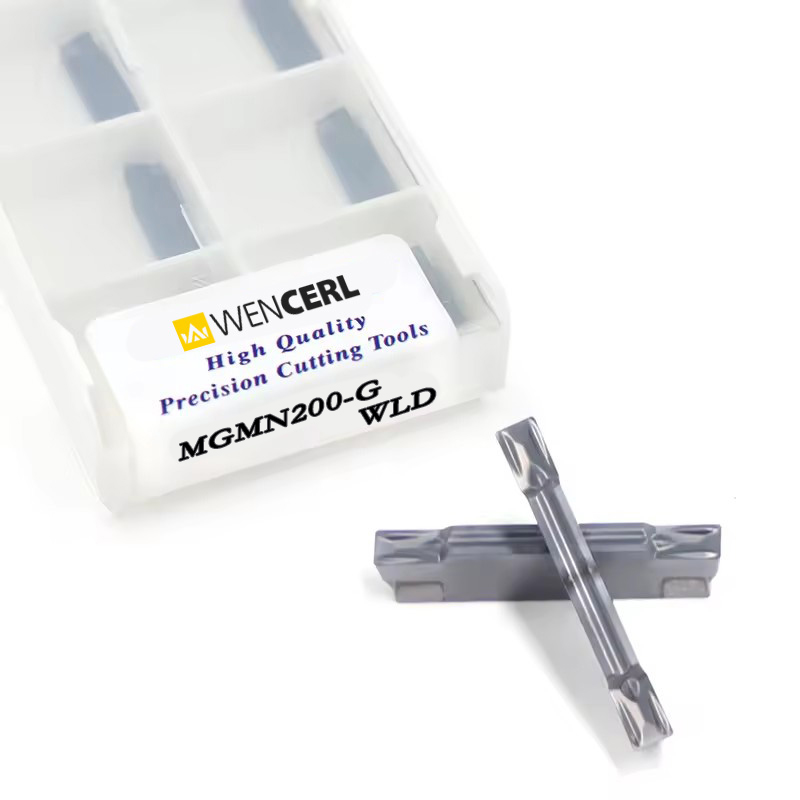
Material-Specific Selection Criteria
The foundation of proper grooving insert selection begins with material compatibility. For aluminum alloys, polycrystalline diamond (PCD) coated inserts deliver superior performance, while stainless steel machining demands TiAlN-coated carbide grades. Hardened steels above HRC50 require ceramic or cubic boron nitride (CBN) inserts, with specialized chip breaker geometries essential for cast iron applications. When processing high-temperature alloys, opt for ultra-fine grain carbide substrates with multilayer coatings like AlCrN+TiSiN for optimal thermal barrier properties.
Geometric Considerations for Groove Profiles
Narrow grooves (<3mm width) necessitate sharp positive rake angles (25-35°), whereas wide groove operations require reinforced dual-edge inserts. Deep grooving applications (>5x tool width) mandate helical edge designs with internal coolant channels, while interrupted cuts demand T-land reinforced edge preparations. Profile-specific requirements dictate special insert geometries – T-slots require matching form tools, while V-grooves need angle-specific inserts (60°/90°/120°) with precise apex positioning capabilities.
Cutting Parameter Optimization
High-speed operations (Vc>300m/min) pair best with oxidation-resistant coatings, and heavy depth-of-cut (ap>6mm) situations require large nose radii (R0.8+). Vibration-prone setups benefit from dampened variable-pitch designs, while automated production lines should utilize smart inserts with wear-indicator grooves. Dry machining applications require high-temperature coatings like SiAlON, and minimum quantity lubrication (MQL) systems perform optimally with nano-porous coated inserts that enhance lubricant retention.

Economic Efficiency Analysis
Mass production scenarios justify 8-edge indexable inserts, while small-batch operations find better value in 4-edge versatile designs. Difficult-to-machine materials achieve better cost-performance with double-sided inserts, whereas mild steels can utilize economical single-sided versions. Ultra-finishing (Ra<0.8) demands precision-ground edges, contrasting with roughing operations that tolerate pressed inserts for cost reduction. Tool life management strategies must align with dominant wear mechanisms – flank wear suggests coating upgrades, while crater wear indicates need for substrate improvements.
Specialized Application Solutions
Composite materials require PCD inserts with 15-20° rake angles, and thin-wall components need low-cutting-force designs (<0.1mm land width). Gummy materials perform best with polished rake faces, while stacked material machining requires variable-angle specialty inserts. Extreme conditions like internal grooving demand self-piloting designs, and high-temperature environments call for monolithic ceramic inserts.
System Stability Requirements
Long-overhang situations (L/D>4) necessitate vibration-damped tool holders with matched inserts, and low-rigidity machines require reduced edge sharpness. Smart manufacturing environments should prioritize RFID-enabled traceable inserts, while heavy-duty operations must verify insert clamping torque capacity. Final selection requires empirical verification through cutting tests – the ideal insert must simultaneously satisfy surface finish requirements, production efficiency targets, and tool life expectations while maintaining acceptable noise levels throughout the operational envelope.

Emerging Technology Integration
Modern insert selection now incorporates digital twin simulations for pre-production testing, with AI-assisted wear prediction algorithms becoming increasingly valuable. Nano-structured coatings and hybrid insert materials continue to push performance boundaries, while IoT-enabled inserts provide real-time process monitoring capabilities. These advancements enable more scientific selection methodologies that transcend traditional trial-and-error approaches.
By systematically evaluating these technical parameters against specific application requirements, manufacturers can achieve optimal grooving performance with minimized production costs and maximized process reliability. The most effective insert selection strategy always balances theoretical knowledge with practical experience, creating a feedback loop for continuous machining process improvement.
Contact us:[email protected]