

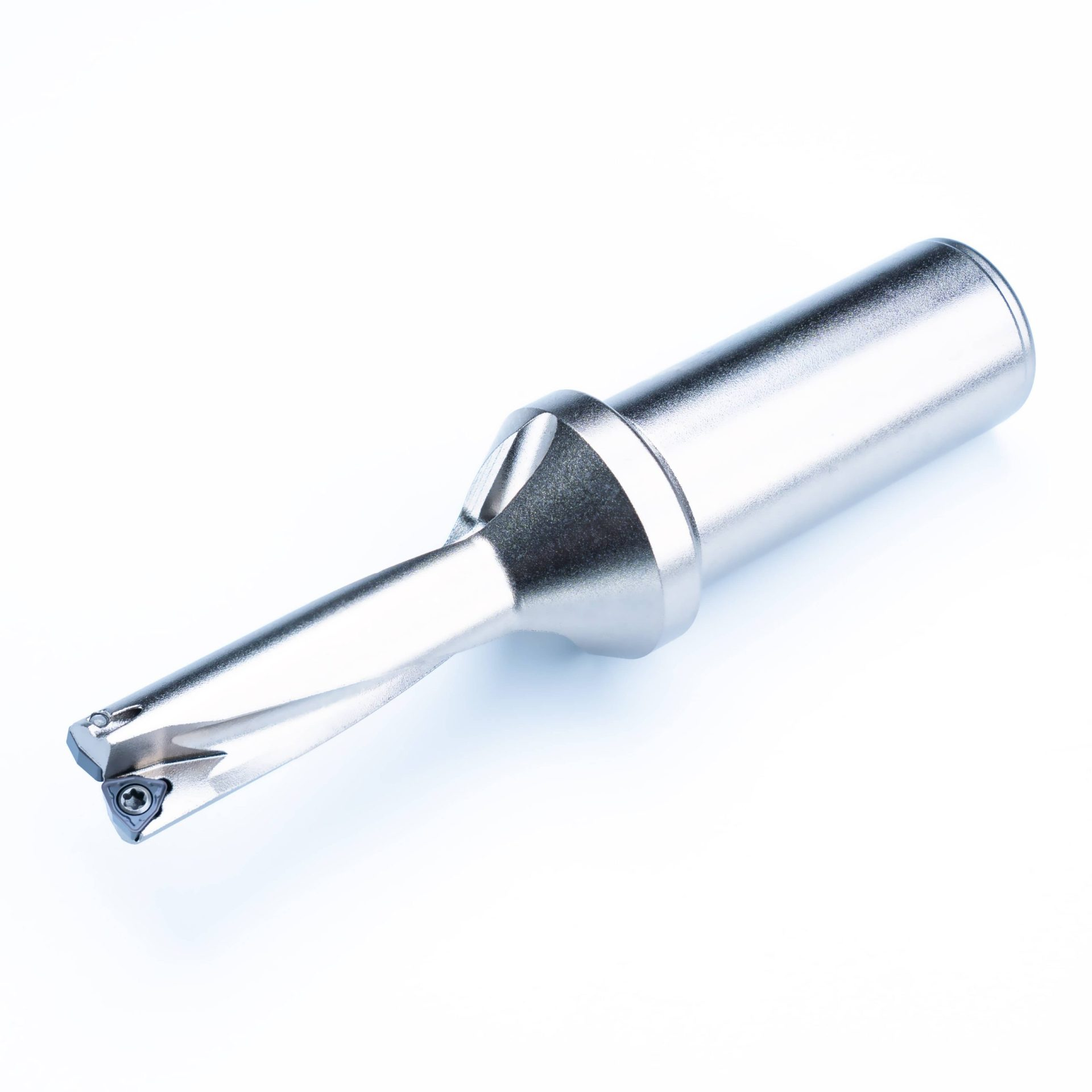
WC (Tungsten Carbide) U-drills demand absolute machine stability due to their brittle nature. Ensure the machining center has minimal runout (<0.02mm) and use high-precision hydraulic or shrink-fit tool holders. The workpiece must be securely clamped, with supporting jigs placed within 3xD of the drilling depth to prevent vibration-induced tool fracture.
2. Coolant System Optimization
High-pressure through-coolant (minimum 70bar) is non-negotiable for effective chip evacuation. Configure coolant nozzles to deliver 30% flow to the drill tip and 70% along the flutes. For deep-hole applications (>5xD), employ oil-mist coolant with 7-10% concentration to reduce thermal shock on carbide.
3. Cutting Parameter Strategy
Adopt “low RPM, high feed” principles:
- Start at 60% recommended speed for the first 3 holes
- Gradually increase to 100-120m/min for steel
- Maintain chip thickness >0.1mm/rev to prevent edge chipping
- Never interrupt feed during cutting to avoid tool breakage

4. Material-Specific Adjustments
For stainless steels: Reduce speed by 20% and increase feed 15% to work-harden below the cutting edge. When machining cast iron, disable coolant and use compressed air to prevent carbide thermal cracking. With titanium alloys, maintain constant feed above 0.15mm/rev to avoid built-up edge.
5. Tool Inspection Protocol
Implement a 5-point pre-use checklist:
-
Flute integrity under 10X magnification
-
Corner radius wear (<0.05mm variation)
-
Coolant hole obstruction test
-
Shank taper cleanliness
-
Runout verification with dial indicator
6. Chip Control Criticality
Acceptable chips should form tight “6” or “9” shapes – straight chips indicate insufficient feed, while dust-like chips suggest excessive speed. For problematic materials, modify the drill’s chip breaker geometry rather than changing parameters drastically.
7. Preset and Runoff Practices
Always perform a 2mm “pecking start” for hole positioning, then continue with full-depth cutting. Program a 0.5xD overrun at hole bottom to ensure complete penetration. For through-holes, reduce feed by 30% during breakthrough to protect the minor cutting edge.
8. Regrinding Specifications
Limit regrinds to 3 times maximum, maintaining original:
- 140° point angle tolerance (±1°)
- Web thickness within 0.02mm of OEM specs
- Helix angle consistency (±0.5°)
- Always use diamond grinding wheels with <15μm grit
9. Emergency Response
If abnormal vibration occurs:
-
Immediately stop feed but maintain rotation
-
Retract tool at 50% drilling feed rate
-
Never reverse rotation while engaged
-
Inspect tool and workpiece before restarting

10. Economic Utilization
Maximize tool life through:
- Dedicated tool slots to prevent mix-ups
- Temperature-controlled storage (20±2°C)
- Using tool life management software
- Implementing tool presetters with <2μm accuracy
By adhering to these protocols, WC U-drills can deliver exceptional performance with 0.005mm hole tolerance repeatability and 300+ hole tool life in most applications. Remember that successful carbide U-drilling depends 80% on preparation and 20% on execution – proper planning prevents premature tool failure.
Contact us:[email protected]