

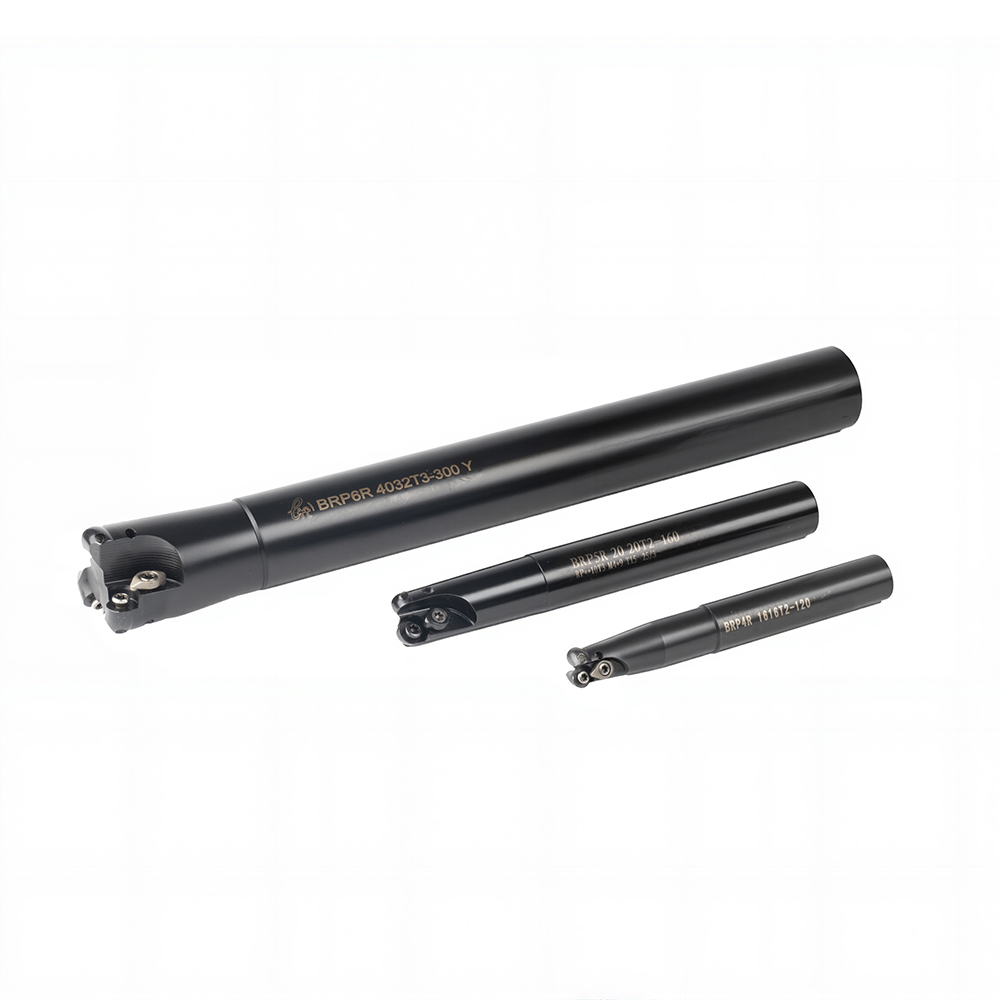
1. Basic Definition and Design Philosophy
BRP (Brazed Radial Profile) Cutters: Feature brazed carbide tips with a radial (curved) cutting edge geometry, optimized for specific profile milling operations. The brazed construction provides robust support for heavy cuts.
BAP (Brazed Angular Profile) Cutters: Use brazed carbide inserts with an angular (straight or inclined) cutting edge, designed for chamfering, beveling, and precise angular milling tasks.
2. Primary Cutting Geometry Differences
BRP Cutters:
Radial cutting edges follow a curved profile, making them ideal for contouring, concave/convex surface milling, and smooth transitional cuts.
Excel in applications requiring consistent finish quality on complex 3D shapes (e.g., mold/die machining).
BAP Cutters:
Angular edges (e.g., 45°, 60°) enable precise bevels, chamfers, or flat-angled surfaces.
Commonly used for edge preparation, weld seam milling, or machining angled slots.

3. Material and Tool Construction
Both use brazed carbide tips for durability, but:
BRP emphasizes curved-edge strength for prolonged radial forces.
BAP prioritizes sharp, angular edges for clean, burr-free bevels.
4. Typical Applications
BRP Cutters:
Aerospace turbine blade profiling.
Automotive mold finishing.
Sculpted surface machining (e.g., impellers).
BAP Cutters:
Weld preparation (e.g., pipe beveling).
Deburring and chamfering edges.
Machining angled features in structural components.
5. Advantages and Limitations
BRP Advantages:
Superior for organic, freeform shapes.
Reduced vibration in profile milling.
BAP Advantages:
Faster setup for repetitive angular cuts.
Better edge sharpness for clean bevels.
Shared Limitations:
Brazed tips are less replaceable than indexable inserts.
Not ideal for high-speed machining vs. modern solid-carbide tools.
6. Selection Guidance
Choose BRP for curved-surface milling and BAP for angular/bevel-focused tasks. For heavy-duty profiling, BRP is preferred, while BAP excels in precision edge work.

Conclusion
While both are brazed-carbide tools, BRP and BAP serve distinct purposes—BRP for radial contours, BAP for angular precision.
Understanding their geometries ensures optimal performance in specialized milling applications.
- Contact us:[email protected]