

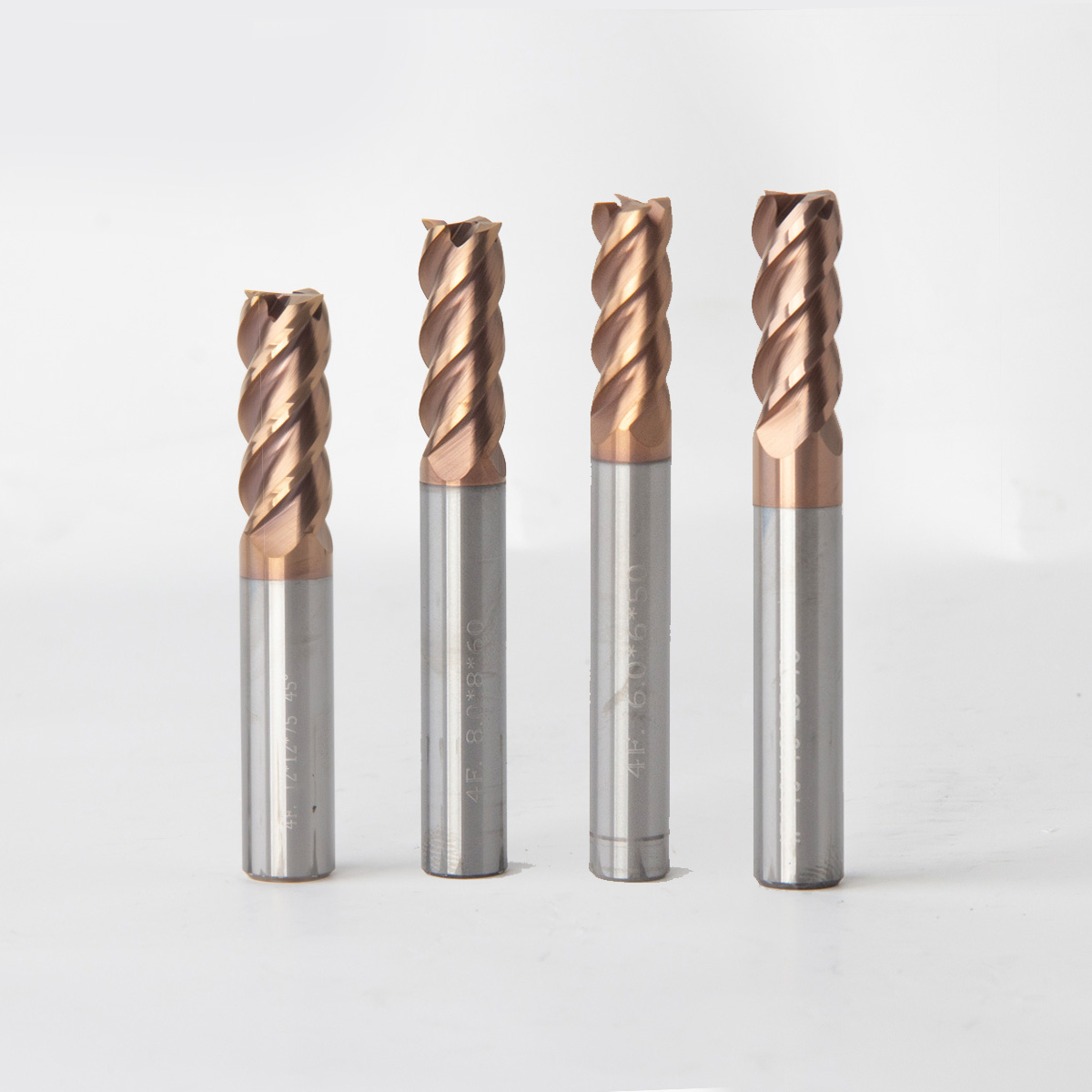
Fundamental Helix Angle Characteristics
Helix angles in end mills range from 10° (low helix) to 60° (high helix), each offering distinct performance advantages. Low-helix designs (10-25°) provide maximum rigidity for hard materials, while medium-helix (30-45°) balances chip evacuation and tool strength. High-helix configurations (45-60°) excel in soft materials and finishing operations. The helix angle directly influences axial/radial force distribution – every 10° increase reduces cutting forces by 15% but decreases tool stiffness by approximately 20%.
Material-Specific Application Rules
For hardened steels (HRC45+), 10-20° helix angles minimize tool deflection and prevent edge chipping. Titanium alloys require 30-35° helices to control heat generation while maintaining adequate strength. Aluminum machining demands 40-45° or higher for efficient chip ejection, with some aerospace-specific tools reaching 60° for optimal surface finish. Composite materials perform best with variable helix designs (35-50° differential) that reduce delamination risk. When processing stainless steels, 25-30° helices prevent work hardening while ensuring chip control.
Operation-Type Optimization
Roughing operations benefit from 25-35° standard helices that balance metal removal rates with tool life. Finishing cuts achieve superior surface finishes with 40-50° high-helix tools that reduce vibration. Slotting applications require lower helix angles (15-25°) to prevent tool walk and maintain sidewall accuracy. Deep-pocket machining (depth >5xD) mandates 35-45° helices for effective chip evacuation without excessive tool deflection. Thin-wall machining demands high-helix tools (45°+) to minimize part distortion through reduced cutting forces.

Cutting Parameter Synergies
Low-helix tools permit higher feed rates (up to 0.2mm/tooth in steel) but require conservative speeds. High-helix end mills enable 20-30% faster RPMs but need reduced feeds to prevent deflection. The optimal helix angle changes with engagement: 90° side milling works best with 30-35° helices, while 10% radial stepovers can utilize 45°+ tools for maximum productivity. Modern toolpaths like trochoidal milling perform exceptionally well with 38-42° helix angles that balance chip thinning effects with tool stability.
Specialized Helix Configurations
Variable helix tools (differing angles per flute) break harmonic vibrations, extending tool life 3X in difficult materials. Progressive helix designs change angle along the flute length – lower near the shank for rigidity, higher at the tip for chip removal. Left-hand helix tools (35-45°) provide downward cutting forces ideal for thin floors, while right-hand variants suit conventional applications. Multi-angle helix tools combine different angles on alternating flutes for vibration-free machining of titanium blisks and other challenging components.
Economic Considerations
High-helix tools typically cost 15-20% more but can improve productivity by 30% in appropriate applications. Low-helix end mills offer better cost-per-edge in heavy roughing but may require additional finishing operations. The break-even point occurs when reduced cycle times offset higher tool costs – typically around 50-part batch sizes for aerospace components. Smart manufacturers maintain helix angle varieties to match specific operation requirements rather than seeking universal tools.

Emerging Technology Integration
Fifth-generation end mills now feature adaptive helix angles that change based on cutting conditions, detected through embedded sensors. Nanocomposite coatings allow higher helix angles in hard materials without sacrificing edge strength. AI-powered selection systems analyze material properties, machine capabilities, and part geometry to recommend optimal helix configurations with 95% accuracy. These advancements continue to expand the performance envelope of helical cutting tools across manufacturing applications.
By strategically matching helix angles to material properties, operation types, and machine capabilities, manufacturers can achieve unprecedented levels of machining efficiency. The most successful operations maintain a diversified tooling portfolio, applying each helix configuration where its unique advantages deliver maximum technical and economic benefits. Proper helix angle selection often proves more impactful than premium substrate or coating choices – making this geometric parameter the silent powerhouse of milling performance.
Contact us:[email protected]