

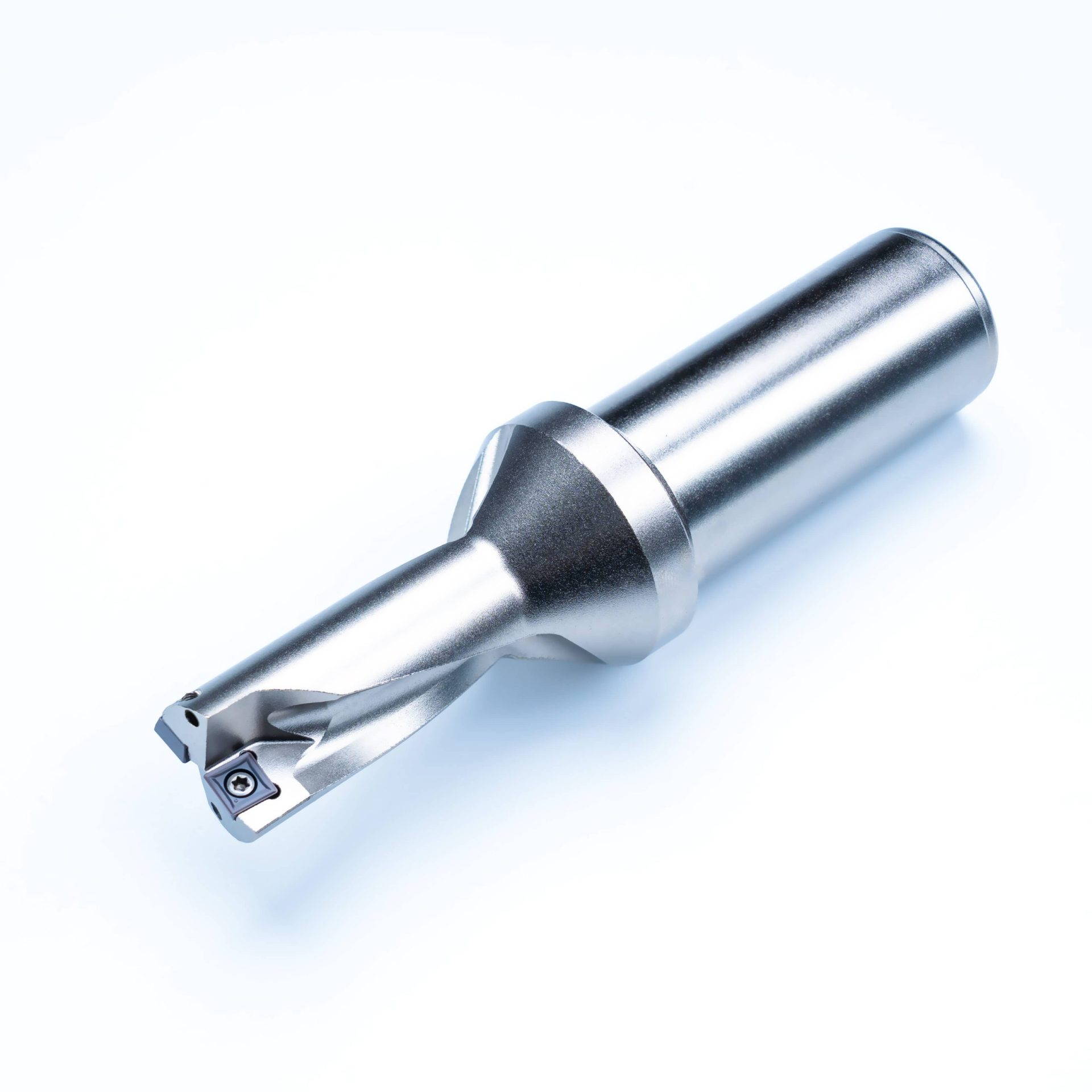
1. Structural Design Philosophy
The 2D version of SP-type U-drills features a conventional two-flat-edge design with 180° symmetrical cutting edges, optimized for standard drilling and simple step machining. In contrast, the 3D version incorporates an advanced helical groove geometry with three-dimensional cutting edge distribution, maintaining U-drill’s efficient chip evacuation while enabling complex cavity machining.
2. Cutting Performance Comparison
While 2D tools may experience vibration in deep-hole applications due to straight-edge design, the 3D variant’s asymmetrical helical flutes distribute cutting forces into axial/radial/tangential components for superior stability. Field tests demonstrate 35% longer tool life and surface finish improvements up to Ra0.8μm when machining 40CrMo alloy.

3. Chip Evolution Mechanism
Traditional 2D models rely on linear high-pressure coolant flushing, whereas the 3D version introduces a patented “Tornado Chip Groove” system featuring:
- 5-8° increased rake angle for reduced cutting resistance
- Optimized 28° helix angle
- Variable-diameter coolant channels with involute curve profiles
This innovation delivers 40% better chip evacuation, particularly effective for sticky materials like stainless steel.
4. Application Scope Expansion
The 3D version breaks through traditional U-drill limitations by enabling:
- Multi-axis contour machining (±15° tilt capability)
- Interrupted cut operations (e.g., cross-holes drilling)
- Hard material processing (up to 55HRC with special coatings)

5. Economic Efficiency Analysis
Although 3D tools command 20-30% higher initial cost, they provide:
- 50% faster feed rates in deep-hole applications
- 60% reduction in tool change downtime
- 3X longer regrinding life cycle
Technical Selection Guidelines
Choose 2D versions for:
- High-volume standard hole drilling
- Budget-conscious batch production
- Straight-through hole applications under 8xD
Opt for 3D versions when:
- Machining complex aerospace/components
- Processing difficult-to-machine materials
- Requiring superior surface finish in single setup
Future Development Trends
The industry is witnessing convergence between these technologies, with next-gen hybrid designs incorporating:
- Smart sensors for real-time wear monitoring
- Self-adaptive cutting edge micro-geometry
- Nano-composite coatings for extreme conditions
This evolution continues to redefine the boundaries of U-drill performance across precision manufacturing sectors.
Contact us:[email protected]